Article
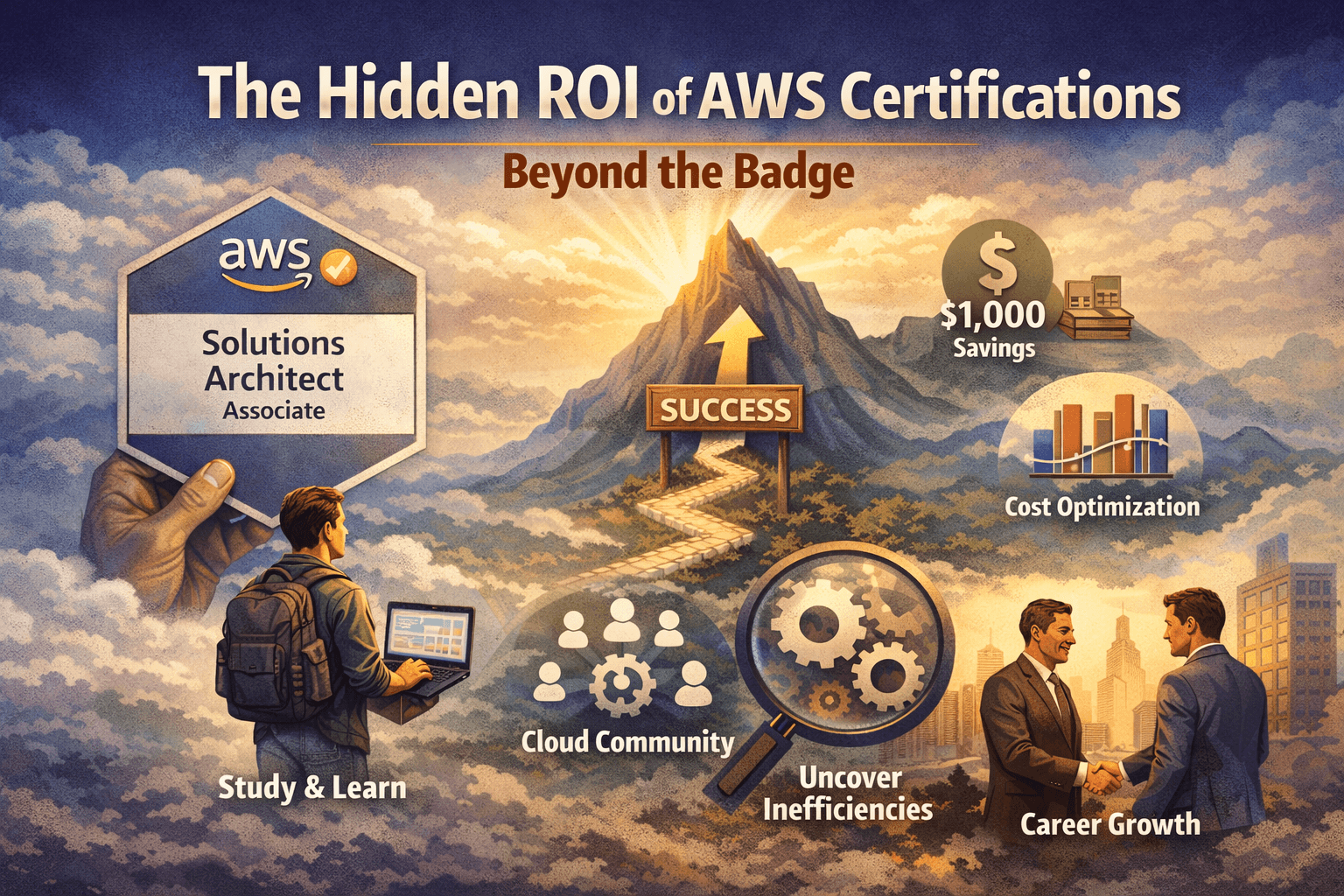
The Hidden ROI of AWS Certifications: Beyond the Badge
Jan 9, 2026
5 minute read

By
Andy Van Becelaere
Cloud Architect
Share
The Unexpected Journey Begins
About a decade ago, when I first started studying for my AWS Solutions Architect Associate certification, I thought I knew what I was getting into. I’d been working with AWS for a about a year, building applications, deploying infrastructure, and generally feeling pretty confident about my cloud skills. The certification seemed like a logical next step, a way to validate what I already knew and maybe open a few doors along the way.
What I didn’t expect was how completely wrong I was about the actual value proposition.
Sure, I got the badge. Yes, it looks nice on LinkedIn, and it definitely came up in conversations with recruiters and clients. But those obvious benefits turned out to be just the tip of the iceberg. The real return on investment showed up in places I never anticipated, and honestly, if I’d known about these hidden advantages upfront, I would have pursued certification much earlier in my career.
Discovering Inefficiencies I Didn’t Know Existed
The first surprise hit me about three weeks into my study plan. I was working through a practice question about AWS Organizations and service control policies, and I realized something uncomfortable. I’d been managing multiple AWS accounts for over a year, but I’d been doing it in the most inefficient, error-prone way possible. The certification prep forced me to actually understand the proper architecture patterns, not just cobble together solutions that technically worked. Within a month of passing the exam, I’d restructured our account hierarchy and saved my team probably ten hours a week in manual work. That time savings alone paid for the certification prep materials several times over.
But the knowledge gaps went deeper than I wanted to admit. I’d been that developer who stuck to the services I knew well. EC2, RDS, S3, maybe some Lambda if I was feeling adventurous. The certification exam doesn’t let you hide in your comfort zone. It demands that you understand the entire ecosystem, including services you’ve never touched and probably didn’t even know existed. Studying for the exam, I discovered AWS Systems Manager, which completely changed how we handled configuration management. I learned about AWS Cost Explorer and AWS Budgets in detail, not just as tools that existed somewhere, but as practical solutions to problems we were actively facing.
The $1,000 Monthly Wake-Up Call
The cost optimization revelation deserves its own paragraph because it was genuinely shocking. While preparing for questions about different storage classes and data transfer pricing, I started actually analyzing our own AWS bill with fresh eyes. We’d been storing terabytes of infrequently accessed data in S3 Standard when S3 Glacier would have worked perfectly fine. We had EC2 instances running 24/7 that could easily have been scheduled or replaced with Lambda functions. We were paying for data transfer that could have been eliminated with better VPC design. I found over $1,000 in monthly savings just by applying concepts I learned while studying. The certification exam fee was $150. You do the math.
From Hedging to Confidence
Then there’s the confidence factor, which sounds soft and fuzzy until you’re in a client meeting and it actually matters. Before certification, when a client asked about implementing a particular solution, I’d hedge my answers. “We could probably do that with AWS, let me research the best approach.” After certification, those conversations changed completely. I could immediately map their requirements to specific AWS services, discuss trade-offs between different approaches, and provide accurate effort estimates. That confidence translated directly into winning projects we might have lost to competitors who seemed more knowledgeable.
Building a Community of Cloud Practitioners
The networking benefits went beyond just having a credential to list. The certification process connected me with a community of people who were serious about cloud architecture. Study groups, online forums, local AWS meetups where everyone was working toward similar goals. These connections led to job opportunities, consulting gigs, and collaborative projects that never would have materialized otherwise.
Perhaps the most unexpected advantage was how certification changed my approach to learning itself. The exam forces you to understand not just what services do, but why they exist and when to use them. That framework for thinking about technology stuck with me long after the exam. When AWS releases new services now, I can quickly evaluate them and understand where they fit in the ecosystem. I’m not just reacting to new technology, I’m able to proactively assess whether it solves problems we’re facing.
There’s also something to be said for the discipline required to actually complete certification. It’s easy to say you’re going to learn something new. It’s much harder to commit to a structured study plan, work through difficult concepts, and actually validate that knowledge with an exam. That discipline carries over into other areas of professional development. After completing my first AWS certification, I found it easier to tackle other challenging learning goals because I’d proven to myself that I could do it.
Career Momentum and Credibility
The career conversations changed in subtle but important ways. Recruiters started reaching out with more senior positions. Clients took my architectural recommendations more seriously. Internal discussions about technical direction suddenly included me more prominently. None of this was because the certification magically made me smarter or more capable. But it served as a signal that I’d invested in deep, structured learning rather than just picking up knowledge haphazardly.
Looking back, the actual exam was probably the least valuable part of the entire experience. Don’t get me wrong, passing felt great, and the credential has opened doors. But the real ROI came from the forced deep dive into services and patterns I’d been avoiding, the cost optimizations I discovered along the way, the confidence boost in client interactions, and the community connections that emerged from the process.
That SA Associate certificate was just the beginning. Over the next several years, I went on to earn 15 more AWS certifications, eventually joining the AWS Training and Certification Subject Matter Expert (SME) program. I’ve contributed to multiple certification exams, helping shape the questions that test cloud practitioners around the world. In fact, some of the questions on today’s exams were written by me — a full-circle moment that still feels surreal when I think about where this journey started.
Your Turn to Invest in the Journey
If you’re on the fence about pursuing AWS certification, stop thinking about it as just a badge to collect. Think about it as structured, intensive training that will expose gaps in your knowledge you didn’t know existed, force you to understand the full breadth of what’s possible in the cloud, and quite possibly save your organization more money than you’d expect. The badge is nice, but it’s really just a souvenir from a much more valuable journey.
What hidden benefits have you discovered from professional certifications?
Whether it’s AWS or another platform, I’d love to hear about the unexpected returns that made the investment worthwhile.