Article
Multi-Certification Strategy: Which AWS Cert Should You Tackle Next?
Jan 9, 2026
9 minute read

By
Andy Van Becelaere
Cloud Architect
Share
A Common Mistake: Random Certification Collection
Passing your first AWS certification feels fantastic. You’ve validated your knowledge, proven your commitment to learning, and earned a credential that carries real weight in the industry. Then comes the question that almost everyone asks: what’s next?
I’ve watched countless people make the same mistake at this crossroads. They pick their next certification based on what sounds impressive or what someone on Reddit recommended, without thinking strategically about their career goals or how certifications build on each other. Six months later, they’re frustrated because they’re studying material that doesn’t connect to their daily work or struggling with concepts that assume knowledge they don’t have.
The truth is that AWS certifications aren’t meant to be collected randomly like trading cards. They’re designed with intentional progression paths that build on foundational knowledge and branch into specializations. Understanding these paths and choosing strategically can accelerate your learning and create genuine career leverage rather than just accumulating badges.
Starting Point
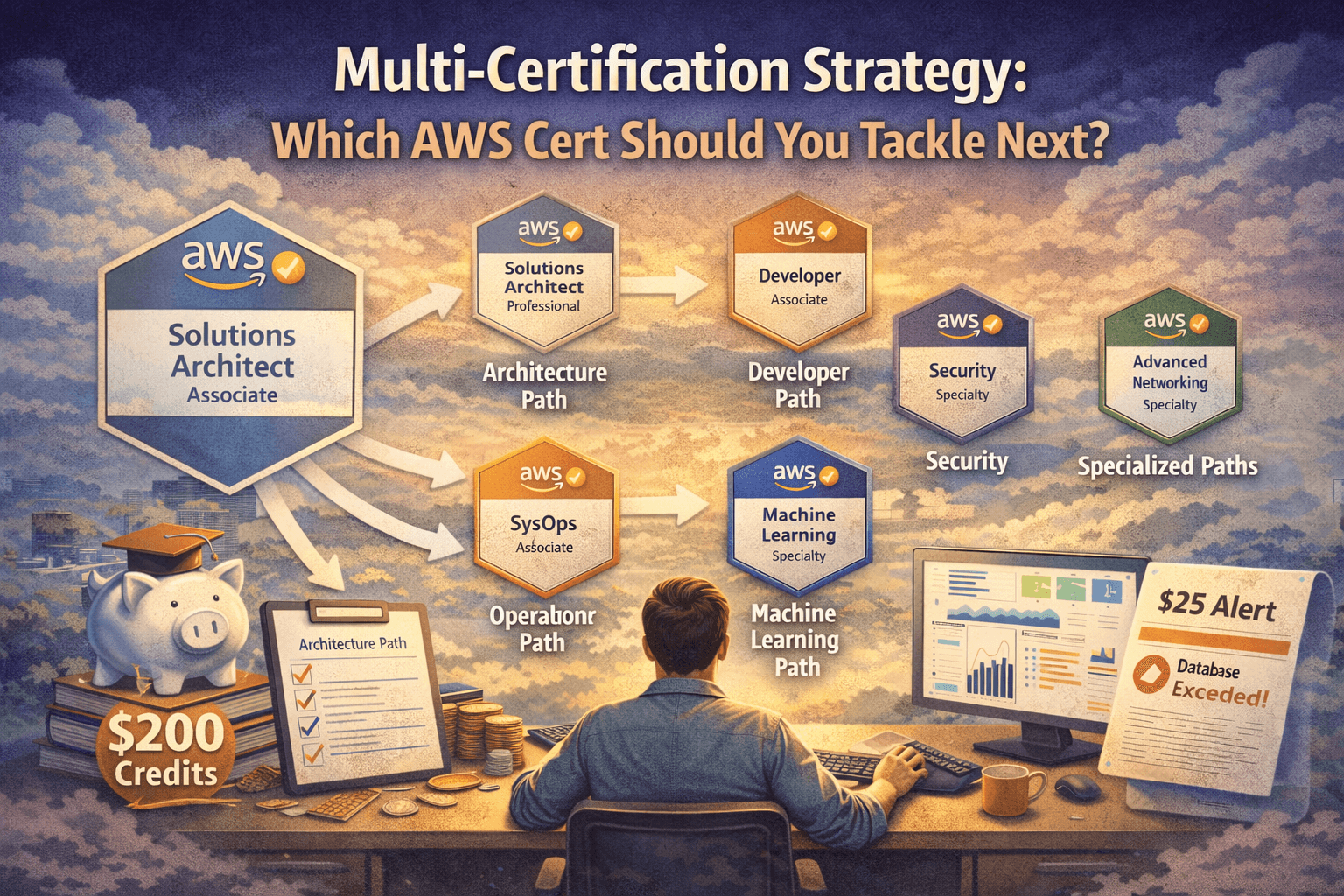
Most people start with the AWS Certified Solutions Architect Associate, and for good reason. It provides the broadest overview of AWS services and architectural patterns. If this was your first certification, you’ve built a solid foundation that opens up multiple paths forward. The question is which path aligns with where you want to go professionally.
The Architecture Path: Building Enterprise-Scale Solutions
The architecture path is the most common progression, and it makes sense for people who want to design and oversee large-scale systems. After Solutions Architect Associate, the natural next step is Solutions Architect Professional. This isn’t just a harder version of the Associate exam. It goes deeper into complex architectural patterns, multi-account strategies, hybrid cloud designs, and migration planning. The scenarios are more nuanced, often involving trade-offs between multiple valid approaches rather than clear right and wrong answers.
I took this path myself, and the jump in difficulty was significant. The Associate exam tests whether you understand what services do and when to use them. The Professional exam tests whether you can design complete solutions that balance cost, performance, security, and operational complexity. It assumes you’ve actually implemented the patterns from the Associate level and are ready to think about enterprise-scale challenges. The preparation took me about three months of serious study, even with the Associate certification fresh in my mind. But the payoff was substantial. Client conversations changed immediately. I was suddenly being brought into architectural discussions at a strategic level rather than just implementation details.
The Operations Path: Running and Managing Infrastructure
The operations path makes sense if you’re focused on running and managing AWS infrastructure rather than designing it. The SysOps Administrator Associate certification dives deep into deployment, management, and operations on AWS. It covers monitoring, logging, automation, security operations, and troubleshooting in much more detail than the Solutions Architect track. If your daily work involves keeping systems running, responding to incidents, and optimizing operational efficiency, this certification aligns perfectly with what you’re already doing.
What surprised me about the SysOps certification was how much overlap it had with Solutions Architect Associate, maybe 40% of the content. This made preparation faster because I wasn’t starting from scratch. But the remaining 60% went much deeper into operational concerns that the Solutions Architect exam only touches on. Things like AWS Systems Manager, AWS Config, AWS CloudFormation drift detection, and detailed CloudWatch metrics became central rather than peripheral topics.
The Developer Path: Building Applications on AWS
The developer path is ideal if you’re writing code that runs on AWS rather than designing infrastructure. The Developer Associate certification focuses on SDK usage, API interactions, serverless application development, and CI/CD pipelines. It assumes you’re comfortable with at least one programming language and want to understand how to build applications that leverage AWS services effectively.
I’ve seen developers skip this certification because they assume their coding skills are enough, and that’s a mistake. The Developer certification teaches you patterns and best practices that aren’t obvious from just reading SDK documentation. How to handle retries and exponential backoff properly. How to design applications that work with eventual consistency. How to use AWS X-Ray for distributed tracing. How to implement proper error handling with SQS and dead letter queues. These are the details that separate applications that technically work from applications that work reliably at scale.
The Security Path: Protecting Cloud Infrastructure
The security path has become increasingly important as organizations take cloud security more seriously. The Security Specialty certification goes deep into identity and access management, data protection, infrastructure security, incident response, and compliance. If you’re interested in security engineering or need to implement security controls in AWS environments, this certification provides structured knowledge that’s hard to piece together from scattered documentation.
One thing I didn’t expect about the Security Specialty was how much it changed my perspective on architecture in general. After studying security in depth, I started seeing security implications in every architectural decision. That VPC design isn’t just about network topology, it’s about blast radius containment. That S3 bucket configuration isn’t just about access, it’s about data classification and protection. The security mindset became integrated into how I thought about building systems.
The Machine Learning Path: Implementing AI Solutions
The machine learning path is specialized but increasingly relevant. The Machine Learning Specialty certification covers the full ML workflow on AWS, from data preparation through model training, deployment, and monitoring. This certification assumes you understand basic ML concepts and focuses on how to implement ML solutions using AWS services like SageMaker, Comprehend, Rekognition, and others.
I’ll be honest, this was the most challenging certification I’ve pursued because it required knowledge outside my core expertise. I had to learn not just AWS services but fundamental ML concepts. The preparation took longer, probably four months of consistent study. But it opened up opportunities in a growing field and gave me the ability to have informed conversations about ML projects rather than just nodding along when data scientists talked about model training.
Specialized Paths: Database and Advanced Networking
The database specialty and advanced networking specialty are highly focused certifications that make sense if you’re working extensively in those domains. Database Specialty covers database design, migration, deployment, and management across AWS database services. Advanced Networking covers hybrid connectivity, network design, and network automation at scale. These aren’t certifications you pursue casually. They’re for people who spend most of their time working with databases or networks and want deep expertise in those areas.
How to Choose Your Next Certification
So how do you actually choose your next certification? Start by looking at your current role and where you want to be in two years. If you’re doing architectural work and want to move into senior or principal architect roles, the Solutions Architect Professional path makes sense. If you’re in operations and want to become a cloud operations lead, pursue SysOps Administrator and potentially DevOps Engineer Professional. If you’re writing code and want to become a senior developer or technical lead, the Developer Associate path aligns with your trajectory.
Consider the overlap between certifications and how they build on each other. Solutions Architect Associate provides a foundation that makes SysOps Administrator easier. Both of those make DevOps Engineer Professional more approachable. Developer Associate and Solutions Architect Associate together give you a strong foundation for building and deploying applications. Security Specialty builds on any of the associate-level certifications but adds a focused security lens.
Think about the knowledge gaps that are actually holding you back in your current work. Are you struggling with operational issues that better monitoring and automation could solve? SysOps Administrator will help. Are you designing architectures but unsure about security best practices? Security Specialty addresses that gap. Are you working on ML projects but feeling lost in the AWS ML ecosystem? Machine Learning Specialty provides structure.
Don’t underestimate the value of specialty certifications even if they seem niche. I’ve found that deep expertise in a specific area often creates more career opportunities than broad but shallow knowledge across many areas. Organizations are looking for people who can solve specific problems, and specialty certifications signal that focused expertise.
The timing between certifications matters too. I’ve found that spacing certifications about three to six months apart works well. This gives you time to actually use the knowledge from one certification before moving to the next, which reinforces learning and prevents the feeling of just cramming for exams. It also prevents burnout, because certification prep is genuinely demanding if you’re doing it properly.
One strategy I’ve seen work well is alternating between certifications that overlap with your daily work and certifications that stretch you into new areas. Follow a certification that reinforces what you’re already doing with one that expands your capabilities. This keeps learning engaging while ensuring you’re building both depth and breadth.
The recertification requirement is worth considering in your strategy too. AWS certifications expire after three years, which means you’ll need to recertify or take a higher-level exam in the same track. This actually influences the optimal certification path. If you plan to pursue Solutions Architect Professional, doing it within three years of your Associate certification means the Professional exam serves as your recertification. Same logic applies to other tracks.
My Personal Certification Journey
Looking at my own certification journey, I went Solutions Architect Associate, then Solutions Architect Professional about six months later, then Security Specialty about four months after that, then Developer Associate. That path made sense for my career trajectory, moving from general architecture into security-focused architecture while adding development knowledge. Your path will likely look different based on your goals and current role.
The most important thing is to be intentional rather than reactive. Don’t pursue certifications just because they exist or because someone else recommended them. Think about where you want your career to go, identify the knowledge and credentials that will get you there, and build a certification strategy that aligns with that vision.
What’s your certification strategy?
Are you building depth in a specific area or breadth across multiple domains? I’d be interested to hear how you’re thinking about your next certification and what’s driving that decision.